
Sea Stories
Send us your best sea stories using the "Contact Us" link below
Student Meets the Professor
by Cam Thornton ’76
I think back, fifty-plus years ago, to how serendipitous it was that I received orders to the USS Cook (FF-1083), a Knox-class frigate for my First-Class Midshipman Cruise. I’ve never been afraid of hard work nor a willingness to accept any challenge. I promised myself during this summer cruise I would seek out every possible opportunity, ask constant questions and not be afraid of failure. Those six weeks on board the USS Cook during the summer of 1975 taught me more than any text book has ever taught me.
My hard work as a Midshipmen paid off. The Captain, XO and Senior Enlisted felt I would be a good addition to the crew as a junior officer. And so, it was to be. My initial orders as an Ensign were to report to the USS Cook shortly after the ship returned from WestPac and I had finished SWO School in Coronado in early 1977. You talk about the Navy and the sense of humor it can have? With my degree in Psychology fresh in hand, the Navy and “Team Cook” felt that qualified me to become an Engineering Officer!
Over a period of about six months, eight or nine new ensigns and one LTJG reported onboard. I had a head start over my peers because of my midshipman summer in 1975. I pushed hard, and became the first of the ensigns to earn SWO qualification. With that qualification in hand, I was off to Engineering Officer School. Once my SWO qualification was completed, rarely did I see the sun or stars again. The reason I had received orders back to the Cook was to become the Main Propulsion Assistant (MPA).
One final watch before I spent the balance of my time below decks stands out. It ended up being a great experience, and the reason for this “sea story.”
The Cook had a flight deck and hangar for one SH-2 Seasprite (LAMPS I) helicopter. We were underway doing a number of training exercises. Part of the exercises included doing touch and go landings for an SH-2 helicopter. The SH-2 would be joining the ship for a week of training. I was OOD during these flight operations. Ultimately the helicopter landed and was secured to the flight deck. Later that afternoon, after completing my watch, I made my way to the wardroom. I was surprised to see LT. DAVID FITCH, (he may have been a LCDR at the time) one of our NROTC Officer Instructors sitting in the wardroom. He was the pilot of the helicopter that had flown aboard earlier while I was OOD.
I thought what a small world it was. The student is now the professor’s peer, and the student and his team safely brought the professor on board for a week of coordinated team training for fleet exercises. Pretty cool!
USS Cook Lands on Mars
by Cam Thornton ’76
On May 14, 1979, I was responsible for transitioning the USS Cook FF-1083, a 1200 lb dual boiler steam-powered frigate from cold iron status where all boilers, engines and auxiliary systems are completely shut down and powered by shoreside utilities, to light-off status, which is the initial firing and warming up of the propulsion plant. We started this process at 4 AM on May 14th. The entire process is carefully orchestrated and it is done in a step-by-step manner, following a very specific order.
The entire light-off process went very smoothly. About 15 minutes before our planned underway time, both boilers were on line and all engineering systems had been checked, and were ready to go. Our engineering spaces were manned with our Sea and Anchor Detail, made up with our most seasoned enlisted engineering team, awaiting word from the bridge.
Around 0800 we receive our first engine orders, and we are underway. Our home port was 32nd Street Naval Base, San Diego. Everything was normal. Our underway orders today were to high tail it to San Clemente Island, where our gunner’s mates were going to practice. Once we passed the degaussing range near Coronado Island, the bridge rang up ahead full. As Engineering Officer of the Watch (EOOW) I thought to myself that was an unusual speed, since we were still a couple miles away from Bouy 1-SD, which is typically when we would speed up.
No big deal. Everything appeared to be going fine. Soon though the typical chatter on the head-phones used by all of the Sea and Anchor Detail slowed down to a trickle. Then nothing. No one was talking. That caught my attention and was really unusual.
About six minutes later, the bridge changes our speed, slowing us down to ahead 1/3rd. Now zero chatter from anyone. I’m thinking to myself, “something’s going on above deck.” What’s up?”
I attempt to reach the bridge on our Sea and Anchor headphones. Nothing. Again, I try. Nothing. I use the 1-MC. Nothing. Now I’m really thinking to myself, “something is really odd. Communication with the bridge has never been an issue.” Because we were manned with our Sea and Anchor Detail, “Boots,” our best throttleman was in the engine room with me. I’m talking with him now, telling him to “be on your toes.” Before I get “your toes” out of my mouth, the bridge rings up all stop. As you may realize, once a ship rings up “all stop,” the ship keeps on moving through the water. How fast depends on a number of factors. Knowing our ship as I did, I’m thinking a few steps ahead.
One concern is a potential main turbine casualty, so I’m now on the 1-MC – “Bridge-Engine Room, request to spin main engine as necessary.” No response. Again, “Bridge-Engine Room, request to spin main engine as necessary.” No response.
Now I hear what sounds like a foghorn from our ship.
Okay, maybe we are in the soup…and everyone has been focused on sights and potential sounds that might be out in front of our ship. Even so, no one is saying a word on the Sea and Anchor Detail head-phones. I try the 1-MC again. No response.
Now I’m certain I hear our foghorn. I know that our ship is still moving through the water based on our original speed and when we received the ahead 1/3rd order. I can also see that the shaft is still spinning from my perch in the engine room.
Some of you may know, a big challenge with the Knox class frigate was the ship was built with a single steam turbine and a single shaft. If the turbine is hot and the shaft sits too long, you end up with a bowed turbine rotor which causes a turbine casualty. To avoid this casualty, you need to be able to spin the turbine so the shaft and propeller continue moving. You do this by having the throttleman open the throttle and allow steam to enter the main steam valve; to reverse, you close the main ahead steam value and open the astern throttle valve. This action is like a dance, allowing the turbine to rotate slowly forward and backwards, so the propeller shaft does not sit too long.
About 90 seconds have passed since the all stop command. Everything has slowed down in my head. All of the training we have done as a team in the engineering spaces coupled with all of the training we have done with the bridge doing “what-if’s” are running through my head. I’m still trying to get the bridge to talk to me on the 1-MC. Still nothing.
We had a standing order, approved by the Captain and Chief Engineer, that the EOOW could spin the main engine to avoid a casualty, if in his opinion doing so was a prudent act based on the circumstances. I had never been in a position where I needed to make this call before.
The shaft had just stopped spinning a few seconds ago. I gave an order to Boots to spin the main engine in reverse.
Not even five seconds after I finished this order, the bridge rings up back full, immediately followed by ringing the collision alarm, and then they ring up back emergency. The bridge is also making an announcement over the 1-MC “brace for collision.” I can promise you everything is now moving in slow motion as a collision is unfolding. I’m looking around the engine room, wondering if we are about to have something cut through the hull. I’ve given the throttleman an order to open the throttle all the way to the stop, and keep it there. Based on what was going on, it was a prudent order so we could get as much steam into the turbine as possible in an effort to escape the claw that we were attached to.
Our ship had hit something or we had been hit.
We begin to tilt towards starboard. Standing in the engine room, I could feel our single 18-foot propeller doing its best to dig and grab hold of the water, trying to gain traction, trying to pull us in reverse. To the right of the main throttle, we had an inclinometer. I glance at it. We are at 15 degrees starboard, then 20, then 25 degrees. Things are now flying through the air, manuals, books, along with a full coffee pot. Everything not tied down is flying as the ship continues to tilt more to the right. I’m telling the throttleman, keep the throttle open. I’m on the 1-MC to the boiler room and auxiliary room. Just checking in to make sure everyone is okay. All I knew is that the engine room was intact, we did not have damage to the hull. How was the rest of my crew doing?
We are at 27.5, 30, 33 degrees on the inclinometer. The screw is still digging and now I can feel we are beginning to back away from whatever we were attached to. 35 degrees on the inclinometer. How much more can we roll to starboard I’m asking myself?
We hit 38.5 degrees on the inclinometer. The throttleman has a wheel to hold onto. The other two of us in the engine room are holding onto the rear of Boots dungarees and his belt. We did not have anything else to grab onto. After what seemed like an eternity, we are free of what ever we had hit or hit us. We are backing up at back emergency for a solid 75 seconds. The ship rolls back to port and we settle, back on even keel. The bridge rings up all stop.
I’m checking with my entire team. Any damage? Anyone hurt? I’m grateful that we had no damage and no one was hurt. That was a huge blessing. It’s about 11 AM now. My boss, the Chief Engineer, comes down the escape scuttle at 11:03 and grabs the EOOW Log and the Bell Sheet. He takes these logs and locks them in his room safe.
The engineering team did its job well on May 14th. From cold iron status in the morning to getting us back pier side under our own power late that afternoon, our training and team work allowed “Cook Power and Light” to serve our shipmates that day.
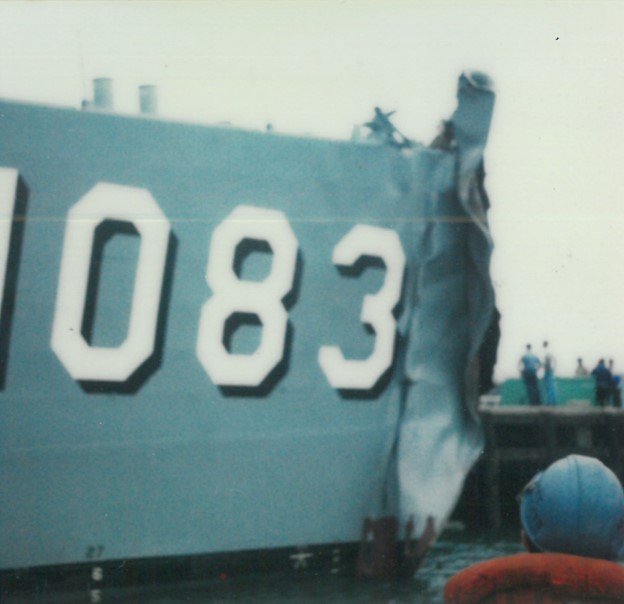
Postscript: The USS Cook collided with the combat stores ship USS MARS (AFS 1) in fog south of Point Loma. The Cook was headed to the San Clemente Island operating area. The collision crushed approximately 20 feet of the Cook’s bow. Seven members of the crew were injured, all cooks. They were hurt by hot water in the enlisted mess while preparing lunch for the crew.
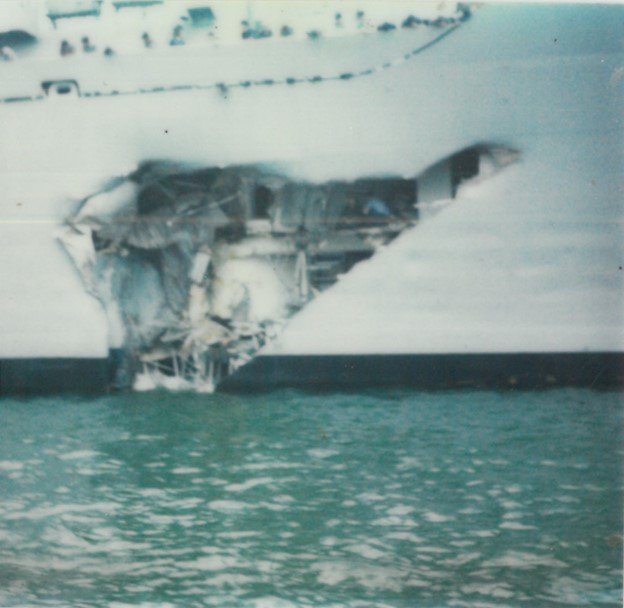
The USS Mars was conducting flight operations off Point Loma, preparing to land a helicopter, in zero visibility weather. Mars sustained a large opening in her starboard side and other structural damage.
The accident led to investigations of navigation, communication and command decisions aboard both ships.
Both commanding officers were relieved of duty. The Commanding Officer of the USS Cook, CDR. Joe Famme, fought back against the inquiry and initial decisions after the collision occurred. It took a number of years, but he ended up clearing his name and his service record was reinstated.
Ultimately it was determined that the Commanding Officer, Executive Officer, Officer of the Deck, CIC Watch Officer and Engineering Officer of the Watch, along with others on board the USS Mars, were guilty of breaking a number of US Naval rules and regulations. The officers on the Mars gun decked official records to match the story told when they docked on May 14th. How they were punished, I do not recall, but ultimately the accident ended a number of careers.
The Captain of the Cook did the right thing. He was a great leader and I was proud to serve under him. His actions on May 14, 1979 saved our ship and the men on it. He initially suffered by being relieved of his command, but he fought back. He had to fight the system, but in the end, he won. The Cook was found to have operated 100% within US Naval rules and regulations on May 14th. All actions taken that day, by all departments during our Sea and Anchor Detail, were cleared as following standard operating procedure when a naval ship enters a fog bank.
Here is a newspaper article about the collision and also a couple of pictures of the damage to both ships.
https://www.newspapers.com/article/the-hanford-sentinel-uss-cook-uss-mars-c/52555653/?locale=en-US